Research
translation &
commercialisation
Discovery of
Innovation Accelerator
Discovery of Innovation Accelerator
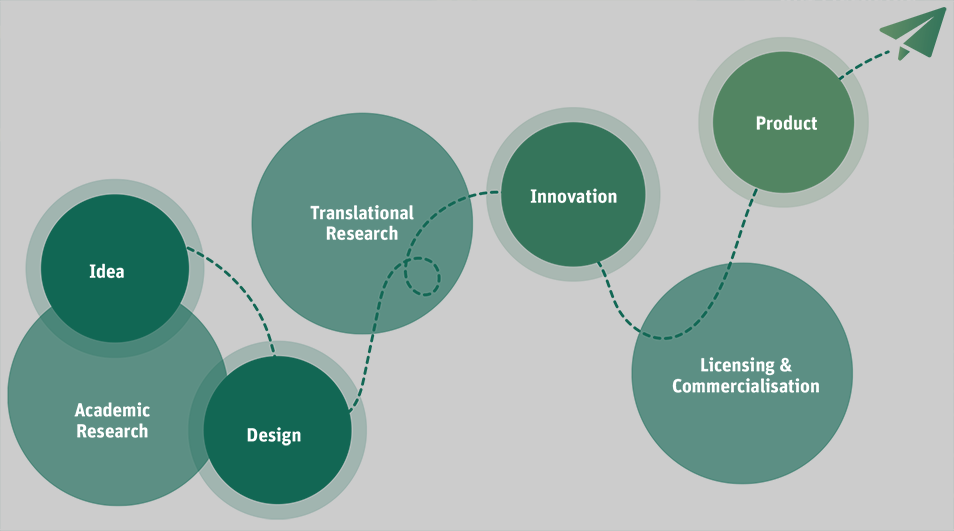
Supported by the Office of the Principal Scientific Adviser to the Government of India and Pratiksha Trust, DIA aims to bridge the gap between academia and industry by breaking the innovation barriers through:
-> Identification of discoveries with potential applications
-> Assessment of discoveries for their scientific credibility, market potential and societal impact
-> Validation and translation into proof of concept
-> Effective transfer of product prototype by successful licensing or spin-offs as start-ups
Click here to know more
DIA serves as a platform where the innovators, industry leaders, regulators and legal advisors can come together to successfully convert technical knowledge into effective solutions/products. DIA works with premier institutes and scientists across India which provides access to deep science discoveries at an early stage. Scientific discoveries then go through steps of assessment, translation and commercialization. The in-house experts work with industry leaders and academic collaborators for de-risking innovations and their successful transition into industry-ready form.
Some examples of our top translated technologies
A. Novel Molecules for Disease Intervention
1. Therapeutics for wound healing and skin cancer: A novel Peptide-based formulation for scarless wound healing and protection against skin cancer. Both of these applications have been patent protected. Collaborator: Dr. Sangita Mukhopadhyay, Centre for DNA Fingerprinting and Diagnostics (CDFD), Hyderabad. Patent status: Provisional Patent filed. Know More
2. Novel biotherapeutic interventions for improved survival during sepsis: Inflammation triggered by sepsis can be fatal even before antibiotics take effect. The novel biotherapeutic interventions improved survival during sepsis. This technology has been out licensed to Netherlands-based startup. Collaborator: Prof. Ravindran Balachandran, Institute of Life Sciences (ILS), Bhubaneswar. Patent status: Patent has been filed in USA, Brazil, Europe, India, South Korea, New Zealand, Australia, Russia, Indonesia and South Africa. Know More
3. Bio-therapeutic agent for boosting respiratory health: DIA has developed a nature-inspired therapeutic molecule with an immune-boosting modality in respiratory health. This technology is an alternative to vaccines and thus help in preventing infections like Influenza; COVID-19 etc. Collaborator: Prof. Ravindran Balachandran, Institute of Life Sciences, Bhubaneswar. Patent has been filed in USA, India and Europe. Know more
4. Small molecules for ameliorating neurodegenerative disorder: The molecules developed here combat neurodegeneration conditions. Collaborator: Prof. Ravi Manjithaya, Jawaharlal Nehru Centre For Advanced Scientific Research, Bengaluru. Patent status: Patent filed in USA and India. Know more
5. Novel Small molecules for HIV intervention: DIA developed immunomodulatory compounds to enhance the host’s immune response to viral infections, complementing existing anti-viral therapies for HIV and other viruses. Collaborator: Prof. Satyajit Mayor, National Centre for Biological Sciences, Bengaluru, Prof. Shahid Jameel, International Centre for Genetic Engineering and Biotechnology (ICGEB), New Delhi and Prof. Satyajit Rath, National Institute of Immunology, (NII), New Delhi. Know more
B. Diagnostics and Devices
1. Bioresorbable edible pill: Edible and digestible pill with an ability to measure gut pH and ammonia levels provides real-time gut physiology read-out. Collaborator: Dr. Sanjiv Sambandan, Indian Institute of Sciences (IISc), Bengaluru. Know more
2. Novel Decontamination Technology: DIA has developed Cold plasma-based decontamination system that eliminates airborne pathogen and Volatile Organic Compounds (VOCs). This system can be tailored to meet the specific needs of diverse industries. This technology has been patented and out-licensed to an Indian Startup. Collaborator: Dr. Alphonsa Joseph, Institute for Plasma Research, Gandhinagar. Patent status: Provisional patent filed. Know more
3. Microfluidic flow analyser: This technology offers low-cost, high-throughput solutions for single-cell analysis and sorting using droplet microfluidics. The initial version, microfluidic analyser is licensed to an Indian start-up. Ongoing developments of the second and third versions are patent protected with industry engagements in-progress. Collaborator: Dr. Anil Prabharkar, IIT Madras, Chennai. Patent status: PCT filed. Know more
4. Rapid Personalised Antibiotic Susceptibility Assay (r-PASA): This technology aims to rapidly identify antibiotic-resistant bacteria (in less than 6 hours) to steward antibiotic usage, thus combating antimicrobial resistant infections. This technology has been out-licensed to an Indian startup. Collaborator: Prof. Yamuna Krishnan, National Centre for Biological Science, Bengaluru. Know more
C. Platform Technologies
1. Enhanced protein production: DIA has developed a method to increase protein production in mammalian cell system. The system developed was able to increase the yields of therapeutic protein molecules such as Erythropoietin (EPO) and Darbepoetin by up to 300%. Collaborator: Dr. Robin Mukhopadhyay, Advance Center for treatment, Research and Education in Cancer, Navi Mumbai. Patent status: Patent field in India
2. Nanoparticle-based drug delivery: This technology uses short protein molecules or peptides that self-assemble into nanometer-sized drug delivery vehicles to target brain tumour (glioblastoma) cells. These nanoparticles have shown to be effective in delivering cargoes of small molecule drugs and siRNAs (small interfering RNAs) into glioblastoma cells. Collaborator: Dr. Varinder Chauhan, International Centre for Genetic Engineering and Biotechnology (ICGEB), New Delhi. Patent status: Patent has been filed in India.
D. Agriculture and Environment
1. Bio Control agents against insect pests in agriculture: A plant-based extract has shown to be effective in controlling several insect pests. This technology is focused towards developing a plant based AphidControl in various plant species. The technology is currently undergoing greenhouse studies and validation by a startup. Collaborator: Dr. Eswara Reddy, CSIR: Insitute of Himalayan Bioresource Technology (IHBT), Palampur & Central Institute for Medicinal and Aromatic Plants (CIMAP), Bengaluru.
2. Bio Control agents against bacterial pathogens in agriculture and poultry: DIA uncovered microbial secretions with potent anti-microbial properties which is effective against plant pathogens such as Xanthomonas sp. In pomegranates and rice, as well as Salmonella sp. in poultry. This technology is currently in a trial agreement with two startups. Dr. Sarangthem Indira Devi, Institute for Bioresources and Sustainable Development, Imphal. Patent status: Know-how has been established.
Scientific Collaborators: